
AI-Powered Mindful Eating Companion
The Engineering Challenge: To move beyond generic diet apps by architecting a context-aware system that adapts to user personality. The goal was to prove that lightweight, fine-tuned LLMs could deliver hyper-personalized health advice effectively on consumer hardware.
Core Architecture:
- Mobile: React Native (Expo) for cross-platform deployment.
- Backend: High-concurrency FastAPI microservice handling logic and PostgreSQL for relational data integrity.
- AI Engine: Meta Llama 3.2 (3B) fine-tuned via LoRA/UnslothAI to optimize inference on T4 GPUs.
Key Technical Implementations:
- Dual-Model Fine-Tuning Strategy: I fine-tuned two distinct models. One predicts Big-5 Personality Traits from user text, and the second generates context-aware eating tips based on those traits.
- High-Quality Dataset Construction: Solved the “garbage-in, garbage-out” problem by constructing a proprietary dataset of 1,500 expert-verified tips. These were mapped to 10 specific eating behaviors and validated by a registered dietitian and psychologist to ensure safety and accuracy.
- Hybrid NLP Integration: Integrated Symanto NLP API for psychographic text analysis on 2,400+ essays to benchmark and augment the local model’s personality prediction capabilities.
- Full-Stack Optimization: Built a seamless pipeline allowing multi-modal logging (text & photo) with real-time AI inference, achieving ~88% user-rated relevance in pilot testing.
What This Solved:
- Personalization at Scale: Bridged the gap between static rule-based apps and expensive human coaching.
- Cost-Effective AI: Demonstrated that quantized, smaller models (3B) can outperform larger generic models when fine-tuned on high-quality domain data.
Tech Stack: Python, FastAPI, React Native, PostgreSQL, Llama 3.2, LoRA, UnslothAI, Docker, AWS EC2.

System Architecture:
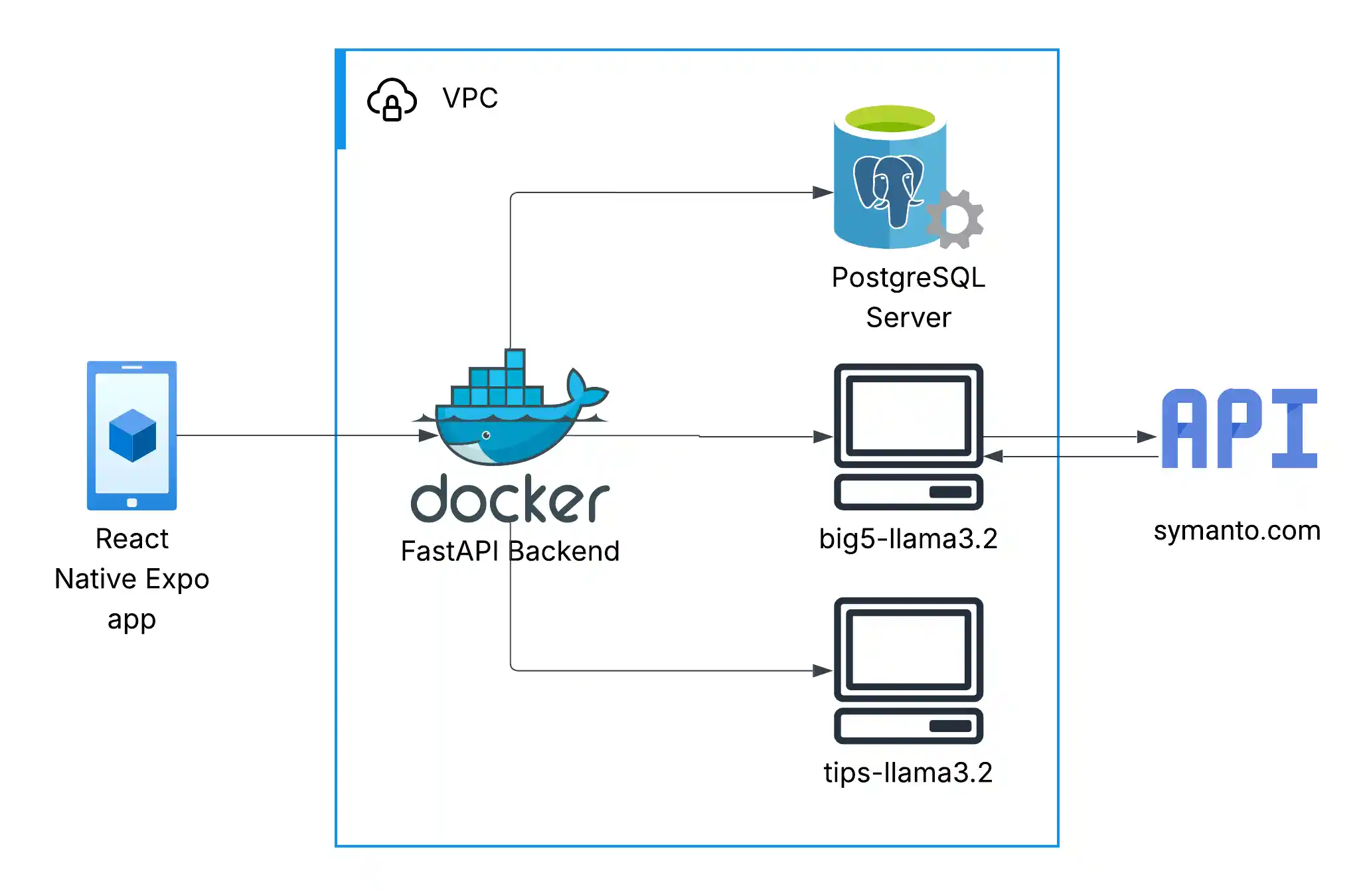
Figure: A look under the hood – the system architecture of the AI-Powered Mindful Eating Companion.